Posts

Showing posts with the label EU copyright

What does the CJEU judgment in the Polish challenge to Article 17 (C-401/19) mean for the transposition and application of that provision?

Image
  On 26 April 2022, the Court of Justice of the European Union (CJEU) delivered its long-awaited judgment in   Poland v European Parliament and Council  (C-401/19) . The Court held Article 17 of the   DSM Directive   compatible with freedom of expression and information under Article 11 of the   EU Charter of Fundamental Rights . In so doing, it rejected the request of the Republic of Poland to annul said provision. The Court also noted how currently no valid alternatives appear to exist to the use of automatic recognition and filtering tools in order to comply with the obligations under Article 17(4)(b)-(c) (para 54). The judgment considers that the liability regime established under Article 17(4) represents a restriction on freedom of expression/information (para 58). Nevertheless such a restriction is not undue. Internal safeguards are provided, of which six key ones are identified (see paras 85-98). Member States are required to consider such safeguards...
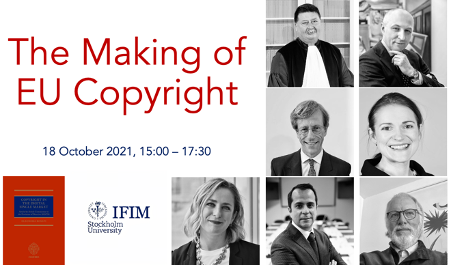
Online conference announcement: 'The Making of EU Copyright'

Image
  2021 is a momentous year for EU copyright law: it is the 30th anniversary since the adoption of the first ever copyright directive (the Software Directive 1991/250) and the 20th since the passing of the seminal InfoSoc Directive 2001/29. By 7 June this year, individual Member States should have also completed their own national processes for the transposition of the Digital Single Market Directive 2019/790. Besides legislative action, what copyright law is today at both the EU and national levels owes significantly to the case law developed over time by the Court of Justice of the European Union (CJEU). In several and notable instances, the Court has added flesh to the structure of thin legislative provisions, addressed technological advancement, and contributed substantially to the establishment of a Single Market for copyright content and copyright-based services. To celebrate the publication of   Copyright in the Digital Single Market. Article-by-Article Commentary to the...

AG Hogan advises CJEU to rule that disclosure of evidence containing protected content to a court is not a communication to the public

Image
IPKat posts as evidence in court? Why not! Image credits: Riana Harvey Does the disclosure in court proceedings of a work protected by copyright or related rights amount to InfoSoc Directive ? Is the notion of ‘public’ in the right of communication/making available to the public in Article 3 therein to be intended in the same way as the notion of ‘public’ in the right of distribution in Article 4? How can copyright protection be reconciled with transparency obligations? a ‘communication to the public’ and/or a ‘distribution to the public’ within the meaning of the  These, in a nutshell, are the issues that the Court of Justice of the European Union (CJEU) will have to address when it decides  BY , C-637/19 , a referral made by the Svea Court of Appeal, Patent and Market Court of Appeal, Stockholm, Sweden. This morning, Advocate General (AG) Hogan issued his  Opinion , in which he advised the Court to rule that the electronic transmission by a litigant or a ...

The legal nature of Article 17 of the Copyright DSM Directive, the (lack of) freedom of Member States, and why the German implementation proposal is not compatible with EU law

Image
Article 17 of the Copyright DSM Directive and the InfoSoc Directive: a special relationship? What is the legal nature of Article 17 of the  Copyright DSM Directive ? What is the relationship InfoSoc Directive ? between that provision and the  These questions, which  might  look at first sight academic in both nature and significance, are actually of great practical relevance, including to determine the room for manoeuvre enjoyed by EU Member States during the (ongoing) national transposition phase. In this sense, it is notable that the German Government has been moving from the idea that the freedom accorded under Article 17 is such that Member States are inter alia entitled to decide whether to introduce exceptions or limitations beyond  both  those specifically referred to in Article 17(7)  and  those listed in Article 5 of the InfoSoc Directive (see the proposed ‘de minimis’ remunerated ‘authorized use’ in  §6 of the German ...

The AG Opinion in YouTube/Cyando: a regressive interpretation of the right of communication to the public

Image
AG Saugmandsgaard Øe A few days ago, The IPKat  reported  on Advocate General (AG) Saugmandsgaard Øe’s  Opinion  in YouTube  and C-683/18  Cyando . When the Court of Justice of the European Union (CJEU) issues its judgment, it will have the opportunity to determine: Joined Cases C-682/18  Whether user-uploaded content (UUC) platforms like YouTube and Uploaded (the latter is a cyberlocker) do perform acts of communication to the public under Article 3(1) of the  InfoSoc Directive   [according to the AG, in principle, they do not] ; Whether the hosting safe harbour in Article 14 of the  E-commerce Directive  is in principle available to these platforms  [according to the AG, it is] ; How to interpret Article 14(1)(a) of the E-commerce Directive and Article 8(3) of the InfoSoc Directive. Possibly (though no questions have been expressly referred on this point), the CJEU will also consider a central aspect of the AG...

When does a communication to the public under EU copyright law need to be to a ‘new public’? A new research article

Image
A public? Over the past several years, the right of communication to the public in art. 3(1) of the  InfoSoc Directive  has progressively and consistently taken centre stage in the EU copyright system. This has been so also given the great number of referrals (over twenty since the 2006 decision in  SGAE ) to the Court of Justice of the European Union (CJEU). EU law does not define the concept of ‘communication to the public’. Lacking a definition, the CJEU has sought to determine the meaning and scope thereof in light of the objectives pursued by the InfoSoc Directive, notably that of ensuring a high level of protection of intellectual property (recital 24). Like the other economic rights harmonised in the InfoSoc Directive, the right of communication to the public “should be understood in a broad sense” (recital 23). The two key requirements of art. 3(1) of the InfoSoc Directive are a ‘communication’ directed at a ‘public’. A simple example might be a free...

BREAKING: CJEU rules that a functional shape may be protected by copyright in so far as it is original

Image
A Brompton Bicycle bike (top) and its alleged counterfeit (bottom) in the background national proceedings Since its seminal ruling  Infopaq  nearly 11 years ago  [Kat-celebration  here ] , the Court of Justice of the European Union (CJEU) has been contributing fundamentally to both shaping and placing the building blocks of copyright protection in the EU.  Through a string of decisions (the most important being  Infopaq ,  BSA ,  FAPL ,  Painer ,  Football Dataco ,  SAS ,  Levola Hengelo , and  Cofemel ), the Court has answered the most basic and relevant question:  When does copyright protection arise? Today, the CJEU has issued  yet another ruling  contributing to this very debate. It did so in the context of a referral from Belgium -  Brompton Bicycle , C-833/18  - concerning copyright protection of functional shapes (in the background proceedings, it is the shape of Brompto...